


How to Select Industrial Biochar Production Equipment for Your Feedstock
Nov 26, 2026
How to Select Industrial Biochar Production Equipment for Your Feedstock
A practical guide for buyers who want to match their raw material to the right line before they ask for a quote.
Screened, dry wood chips or rain-soaked, dusty ones? Your biochar production equipment must handle both. Picture two loads from the same sawmill: one kept indoors, one left out in the rain. The wet load takes more energy to dry and carries more fine dust. It may bridge in the hopper, jam the feeder, and overload the dryer.
That is why feedstock matters so much. The machine does not work with an average material. It works with whatever arrives at the gate that day. This guide shows you how to describe your material honestly, including the bad batches, and ask each supplier how their machines will handle it.
Define Your Feedstock and Its Variability
Before you send an inquiry, ask yourself two questions. What do I need to collect? And can one lab report stand for a whole year of supply? Usually the answer to the second question is no.
Build one profile for each feedstock source. In each profile, record the typical batch and any batch that could change the line design, such as a wet or dusty one. Measure at three points: the material as it arrives, the material as it enters the reactor after pretreatment, and the finished biochar. For every number, write down where the sample was taken, the unit, and the basis used.
It also helps to prepare a side-by-side set for one source, for example two wood chip batches with photos, sampling dates, test values, and storage conditions. If you do not have a measured value yet, write Pending testing instead of guessing. For sampling methods, see ISO 18135 on sampling solid biofuels.
Record Source, Supply, and Batch Conditions
· Source and delivery state. Note the supplier, the origin, the process that creates the material, how it is stored and shipped, and any treatment already done. Also list foreign material such as bark, soil, stones, metal, and coated or chemically treated wood.
· Supply and variation. Record monthly and yearly delivered amounts, the lowest supply you can count on, busy and slow seasons, delivery frequency, and how much batches differ. If you plan to use several feedstocks, say whether you will switch between them or mix them. If you mix, give the planned ratio and how much it may move.
· Sampling plan. Pick typical batches and edge-case batches. Good edge cases are wet rainy-season material, low-density batches, and batches with a lot of fines. Give every sample an ID that links back to its supplier, photos, and test report.
Standardize Measurement and Throughput
Many quote disputes start with numbers measured in different ways. Use the same rules for every supplier.
|
Item |
What to state clearly |
|
Moisture |
Say whether it is wet basis or dry basis, and where the sample was taken. Wet basis divides by the total wet mass. Dry basis divides by the dry mass. For material arriving at the plant, wet basis is the easiest choice. |
|
Particle size and shape |
Record the sieve sizes, the share of each size fraction, and the share of fines and oversize pieces. For stringy chips or long fibres, add the real length. |
|
Bulk density |
Use kg/m³. State the moisture of the sample and how it was packed, such as loose or tapped. |
|
Ash, chlorine, sulfur, and foreign matter |
Report ash, total chlorine, and total sulfur on a dry basis, with units and test methods. If you suspect deposits or wear, also test the ash composition and any mineral contamination. |
|
Supply, equipment throughput, and product output |
Report three separate numbers: wet material arriving, dry material entering the reactor, and qualified biochar produced. Say whether biochar is counted as delivered or on a dry basis. When you convert wet material to reactor dry feed, count both the water and any dry matter lost in pretreatment. |
Translate Feedstock Data into Equipment Requirements
Once you have the data, the next question is which part of the line each number affects, what you should ask the supplier, and when you need a test run.
Work through the line in order: hopper and feeder, reactor, pretreatment, then maintenance. One number can affect several places. Wet fibre, for example, can disturb feeding and also add to the drying load. For every effect, write down the question the supplier must answer and how the answer can be checked.
Ask the engineering team for each model’s inlet conditions, feeder setup, temperature measuring points, drying heat balance, and maintenance records from similar operating conditions. Your project’s inlet limits, stable throughput, energy use, and service intervals should come from the chosen model and its test records.
Feeding and Conveying
Indicator: Particle size, shape, fines, and fibre length
Possible effect: Bridging in the hopper, wrapping on conveyors, feeder jams, uneven dosing
Ask the supplier: The hopper outlet design, the feeder type, and the accepted share of oversize and fines
When to run a test: If there is no comparable run record for your material’s shape or size spread, do a cold continuous feeding test.
Indicator: Bulk density and flow behaviour
Possible effect: Usable hopper volume, mass flow per hour, drive load
Ask the supplier: What feed rate can be held when density changes, how weighing is done, and the load range
When to run a test: If a low-density batch may miss the target dry feed, or if damp or packed material flows very differently, measure flow swings, torque, and blockages.
Reactor Fit and Product Targets
What can be affected. Moisture going into the reactor changes the heat load. Particle size and shape can change how the material heats up and converts. If the material type or blend ratio changes, recheck the heat balance, the biochar yield, and the product quality.
What to ask the supplier. Pyrogreen’s continuous biochar pyrolysis machine route and its autothermal continuous carbonization route both publish a process range of 500–700°C. For the model you plan to buy and your own samples, then confirm the temperature measuring points, the target temperature, the solids residence time, the stable dry feed rate, and the target biochar quality.
When to test. Arrange a hot test if your material goes beyond the proven range, if a blend has not been proven, or if the biochar quality directly decides acceptance. Record the operating conditions and the biochar yield, and test the product for its intended use.
Pretreatment and Line Capacity
Moisture and drying. Use your edge-case batches to calculate the water that must be evaporated and the real dry capacity. Ask the supplier for the moisture before and after drying, the design evaporation rate, the heat source, and the continuous capacity. Wet-season material may limit the capacity of the whole line, and how dried material feeds may be unknown. In those cases, test drying and feeding together.
Size, impurities, and density. Let the test results show whether you need screening, crushing or cutting, impurity removal, feeder adjustment, or densification. Ask the supplier to explain the goal of each step, how much material it loses, and what is included in the supply scope. If crushing creates more fines, or densifying changes how the material feeds or heats, compare samples before and after treatment.
How to use the published screening values. You can list Pyrogreen’s public first-pass guideline of moisture around 15% and particle size under 5 cm. Your technical team should still confirm the moisture basis, how size is measured, where it applies, and what each specific model can accept.
Operating and Maintenance Evidence
|
Question to verify |
Ask the supplier |
Evidence and test conditions |
|
Coking or sticking |
Which hot zones or cold spots in the gas path need checking? How are they cleaned? |
If there is no comparable record, run a hot test and inspect after shutdown. Record the location, temperature, and operating trend. Take samples to tell tar or char buildup from mineral sintering. |
|
Ash buildup and fines carry-over |
How are ash discharged, dust collected, and surfaces cleaned? Are service points easy to reach? |
For high-ash or high-fines batches that have not been proven, check the collected dust, the pressure-drop trend, and the deposits found at shutdown. Read the ash results together with real operating conditions. |
|
Corrosion |
Given the chlorine, sulfur, and gas path, how are the hot end, heat-exchange surfaces, and condensing areas made? |
Check feedstock lab results, zone temperatures, gas atmosphere, and deposit or condensate analysis. If there is no comparable record, consider material coupons or a longer trial. |
|
Wear |
Which parts will meet sand and other hard impurities? How are those parts replaced? |
If contamination changes a lot and no similar record exists, test for mineral content and measure key parts before and after a trial. Judging service life needs long-term records from similar conditions. |
Use a Feedstock Compatibility Matrix to Prioritize Checks
A common question is what to test first, and which judgments must be redone when the feedstock changes. The matrix below compares feedstocks by their delivered state. Only wood chips are named as an example feedstock on Pyrogreen’s category page. Rice husk, empty fruit bunches (EFB), and palm kernel shells (PKS) are included here to help you think through selection. Whether they suit a given machine must be decided by sample testing and equipment trials.
For each feedstock, add photos and test data for one typical batch and one edge-case batch, starting with trial records comparable to the equipment you plan to buy. Mark unmeasured values as Pending testing, and mark each model’s scope and pass criteria as To be confirmed by the technical team.
|
Feedstock |
Check first |
Equipment areas that may be affected |
Pretreatment to consider |
Questions for a trial |
|
Wood chips |
Compare screened, indoor-stored material with rain-soaked, bark-heavy, or long-piece batches. Check moisture, fines, long pieces, density, and foreign matter. |
Hopper, feeder, drying stage, heating in the reactor |
Screening, re-crushing oversize, impurity removal, drying |
Does wet material bridge? After treatment, can the line hold the target dry flow and char quality? |
|
Rice husk |
Compare whole husk with broken husk, or batches with more fines or sand. Check loose bulk density, fines, moisture, and ash. Test silicon and potassium if needed. |
Volumetric dosing, gas–solid separation, discharge, contact parts |
Remove foreign matter, adjust feeding, manage fines, and consider densification if needed |
Is feeding stable with low-density batches? How do fines carry-over, discharge, and deposits behave? |
|
Oil palm empty fruit bunches (EFB) |
Compare wet long fibre, cut material, and pressed, dewatered material. Check moisture, fibre length, density, ash, total chlorine, and total sulfur. Test potassium if needed. |
Hopper discharge, conveying, dewatering and drying, hot end and gas path |
Cutting, dewatering, drying. If test results support it, consider washing, and also count the wastewater and extra drying load. |
After cutting and dewatering, does it feed continuously? Where do hot deposits form, and which components should be analysed? |
|
Palm kernel shells (PKS) |
Compare clean, even shells with wet, dusty, or sandy batches. Check size, moisture, density, foreign matter, and ash. |
Feeder load, crushing and conveying parts, drying, discharge |
Screening, sand removal, metal removal, and crushing or drying if needed |
Is feeding stable at edge-case sizes? How do load and signs of wear differ before and after sand removal? Does the biochar meet the target? |
Plan Pre-Purchase Testing in Three Steps
Before you buy, you need to know what you hand over, what the lab measures, and which questions can only be settled on a machine.
First, submit your material information and pick representative batches. Second, use the lab results to narrow down the pretreatment plan. Third, for any question that still affects selection or acceptance, arrange a cold feeding test, a hot test, or a combined test. If the supplier has data from similar projects, first check that the feedstock state, feeder setup, run time, and biochar target are really comparable.
Ask the technical team for a sample submission template and an anonymized trial report. Sample amount, test duration, the definition of steady state, and pass criteria are all To be confirmed by the technical team, and they should be agreed before the test starts.
|
Pre-purchase testing checklist |
What to submit or record |
What it helps decide |
|
1. You submit feedstock information |
Source and supply, batch variation, photos, existing lab results, current pretreatment, blending or switching plan, target biochar quality and output. Number typical and edge-case samples separately. |
Which batches to test, and which pretreatment and feeder setup to include in the first quote. |
|
2. Lab testing |
Moisture, particle size and shape, bulk density, ash, total chlorine, and total sulfur. Add ash composition, ash melting behaviour, foreign matter, or flowability tests where something looks suspicious. Retest treated samples if needed. |
Whether to evaluate screening, crushing, drying, impurity removal, or feeder changes, and which batches need an equipment test. |
|
3. Equipment trial, if needed |
In a cold test, record feed mass flow, variation, torque or current, and blockages. In a hot test, add pretreatment and reactor conditions, the steady-running period, material balance, biochar yield and quality, energy use, and a shutdown inspection. Note how the test unit differs from the unit you plan to buy. |
The feedstock spec after pretreatment, the feeder setup, and the operating conditions to write into the technical agreement. Also shows which items still need scale-up or longer validation. |
Compare Supplier Proposals on the Same Basis
How do you compare throughput, biochar output, energy use, and scope of supply across quotes? Give every supplier the same feedstock profile, the same edge-case batches, and the same product acceptance target. Then ask each quote to show three numbers together: wet material throughput at arrival, stable dry feed to the reactor, and qualified dry biochar output. Also ask them to say whether each figure comes from a trial, from measured data at a comparable project, or from an engineering estimate.
To help you compare, ask for an anonymized quote table. On the public category page, the indirect-heating route lists dry feed rates of 300 / 600 / 1,500 kg/h, and the autothermal route lists 1,000–8,000 kg/h. If you quote these numbers, say that they are public dry-feed figures. The exact model, suitable feedstock, stable throughput, and biochar output should be confirmed by the technical team for your operating conditions.
· Line up yield and energy use. Biochar yield can be calculated as dry biochar mass divided by dry feed mass into the reactor. Say whether fine char is included. Use the same denominator for external heat and electricity, and be clear about how pretreatment, gas treatment, cooling, and waste-heat use are counted.
· Check edge-case operation and acceptance rules. Compare reduced-load running, cleaning stops, and stable-run records for edge-case batches. Any figure you plan to put in the technical agreement should state the feedstock, run period, measuring point, sampling method, and pass criteria.
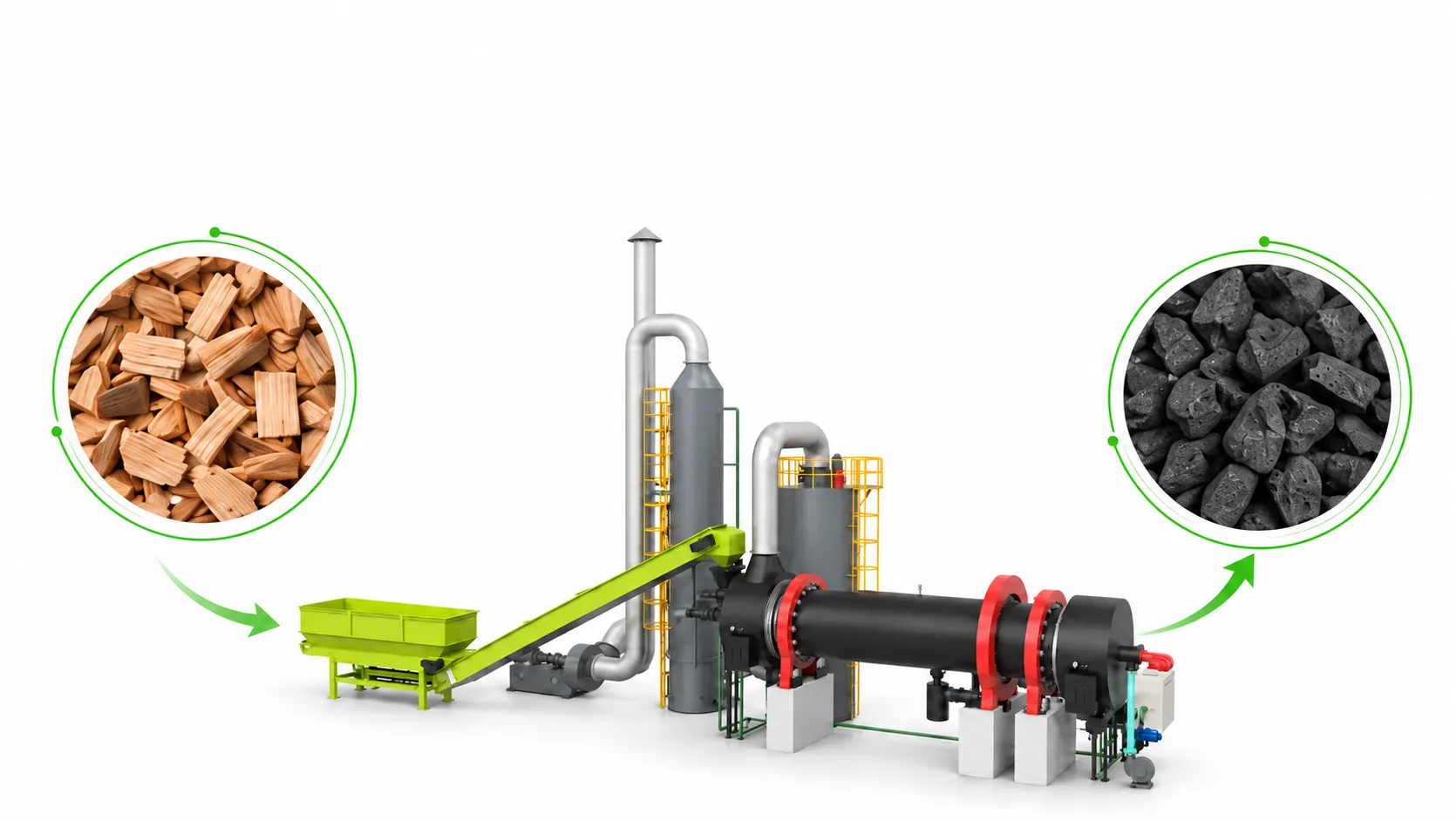
· Look at both carbonization routes. Once you have defined your feedstock and product requirements, compare indirect-heating and autothermal carbonization options in our range of industrial biochar production equipment.
Send a Feedstock Brief to Your Equipment Supplier
What should the first inquiry email include so the supplier can reply with a plan that has engineering behind it?
Fill in one brief for each feedstock, and list batches in clearly different states separately. Say where each estimate comes from, and write Pending testing for anything missing. Ask the supplier to reply with the proposed configuration, the required inlet conditions, the pretreatment scope, the evidence behind their capacity claims, and the tests they recommend. Before you publish or send a template, ask the Pyrogreen technical team to confirm the required fields and sample requirements for a first assessment.
CONTACT US
Contact US
Product Information
Quantity
Unit
Piece
Support order samples, customization, wholesale direct, and complete payment. If the product you look for does not have corresponding customized content, pls fill out the form below to contact us, and we will reply ASAP.