


.webp?x-oss-process=image/resize,w_800/quality,q_100)
.webp?x-oss-process=image/resize,w_800/quality,q_100)
Continuous Carbonization & Torrefaction Equipment
Pyrogreen's equipment portfolio is organized by process and production objective. All three systems use continuous rotary kiln technology, while their heating methods, operating temperatures, and target products differ.

Continuous Biochar Machine
The Continuous Biochar Machine separates the biomass from the combustion gases used to provide process heat. This configuration is suited to biochar and biocarbon projects where greater control over thermal conditions and final-product properties is important.

Autothermal Biochar Production
Equipment
The Autothermal Continuous Carbonization Kiln uses an internal-combustion carbonization route and is designed for continuous industrial biochar production. Its broader throughput range makes it suitable for projects where production capacity is a major selection factor.

Continuous Biomass Torrefaction
Equipment
The Rotary Torrefaction Kiln uses indirect heating at 200-300°C to produce biocoal or torrefied biomass. It is intended for projects where biomass fuel upgrading is more important than producing conventional biochar.
Continuous Carbonization & Torrefaction Equipment
Pyrogreen's equipment portfolio is organized by process and production objective. All three systems use continuous rotary kiln technology, while their heating methods, operating temperatures, and target products differ.
| Comparison | Indirect Rotary Pyrolysis | Autothermal Carbonization | Torrefaction Kiln |
|---|---|---|---|
| Process | Carbonization | Carbonization | Torrefaction |
| Reactor Type | Rotary Kiln | Rotary Kiln | Rotary Kiln |
| Heating Method | Indirect | Autothermal / Internal Combustion | Indirect |
| Operating Mode | Continuous | Continuous | Continuous |
| Process Temperature | 500–700°C | 500–700°C | 200–300°C |
| Recommended Feedstock Moisture | Around 15% | Around 15% | Around 15% |
| Particle Size | <5 cm | <5 cm | <5 cm |
| Dry Feed Rate | 300 / 600 / 1,500 kg/h | 1,000–8,000 kg/h | 1,000–5,000 kg/h |
| Main Output | Biochar / Biocarbon | Biochar | Biocoal / Torrefied Biomass |
| Typical Selection Priority | Process & product control | High-throughput production | Biomass fuel upgrading |
Which System Is Right for Your Project?
Equipment selection should start with the required product and process objective, followed by feedstock characteristics and production capacity.

Choose Indirect Heating When
Process Control Is a Priority
The Indirectly Heated Rotary Pyrolysis Kiln is generally the more suitable route for projects where the carbonization environment and final carbon product require greater control. Typical project objectives include biochar or biocarbon production where process conditions are an important part of product development.

Choose Autothermal Carbonization for
Higher-Throughput Biochar Production
The Autothermal Continuous Carbonization Kiln is designed for continuous industrial production across a broader throughput range. It is suitable for projects where production scale and continuous operation are key considerations and where the feedstock can be prepared to meet the feeding requirements of the system.

Choose Torrefaction for Biomass
Fuel Upgrading
The Rotary Torrefaction Kiln is designed for a different objective. Its lower operating temperature is used to produce torrefied biomass or biocoal for solid-fuel applications. If the primary goal is to improve biomass as a fuel instead of producing conventional biochar, torrefaction is usually the more appropriate process route.
Not sure which route fits your project? Send us your feedstock information and target product for assessment.
Feedstock Requirements for Stable Continuous Operation
Feedstock characteristics have a direct influence on material handling, feeding stability, process configuration, and final product. Equipment selection should therefore consider the material before the carbonization or torrefaction system is specified.
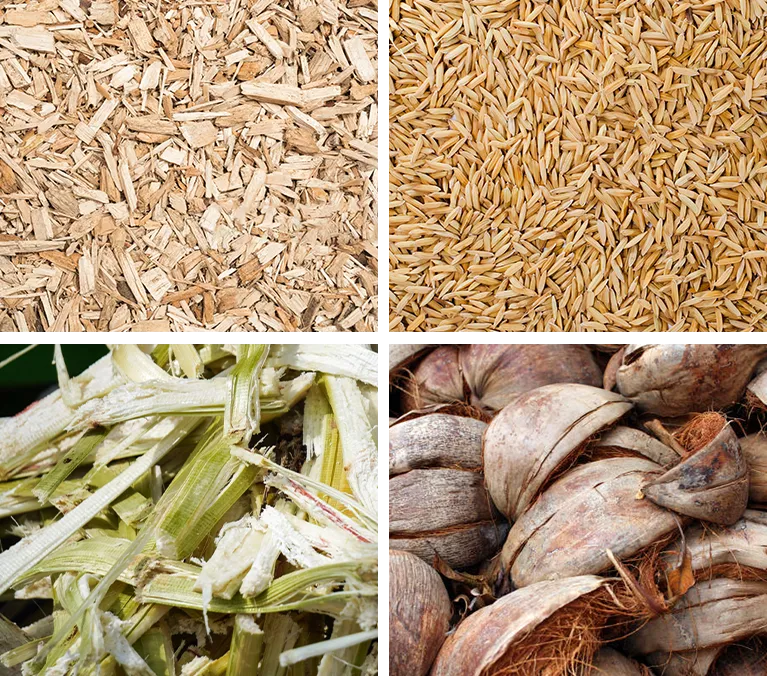
Pyrogreen systems can be configured for biomass such as wood chips, coconut shell, forestry residues, agricultural residues, and other suitable biomass materials.
Fine or low-density materials such as sawdust may require densification before feeding. Depending on the feedstock, other preparation steps may include drying, crushing, sizing, or screening.
Important feedstock factors include moisture content, particle size, bulk density, ash content, and material flow behavior. Pyrogreen evaluates these characteristics when determining the appropriate process and equipment configuration.
Beyond the Kiln: A Complete Biomass Processing System
An industrial biochar or
torrefaction project normally requires more than the core thermal reactor. The overall production line must move
biomass reliably from preparation through thermal processing and then handle the hot solid product and process
gases safely.
A typical system can follow this process:
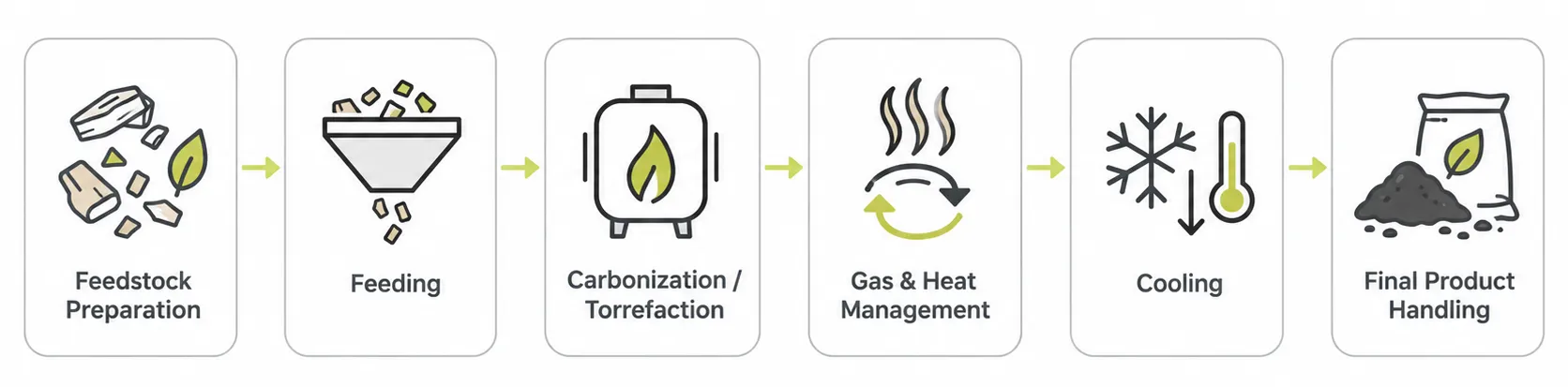
Depending on the project, the production line may include drying and sizing equipment, conveying and feeding systems, the carbonization or torrefaction kiln, process-gas treatment or combustion, heat-recovery equipment, cooling, product discharge and collection, and an integrated control system.
The exact scope depends on the selected technology, feedstock condition, dry-feed capacity, site utilities, and local project requirements. Auxiliary equipment is therefore configured as part of the project rather than treated as a fixed package for every installation.
This system-level approach allows the core kiln and supporting equipment to be designed around the same operating conditions.
Integrated Gas, Heat and Emission Management
Thermal conversion produces gases and heat that need to be considered as part of the overall plant design. Their treatment and potential utilization depend on the selected process and project configuration.


Carbon Products for Different Project Goals
Different thermal processes create carbon products for different end uses. Defining the required product early helps determine the appropriate equipment route.

Biochar
Biochar can be produced for agricultural, environmental, and carbon-management applications. Required properties vary by feedstock, process conditions, and intended use.

Biocarbon
Biocarbon can serve industrial applications where renewable carbon materials are used as alternatives to conventional fossil-derived carbon sources. Product requirements should be defined according to the downstream process.

Biocoal / Torrefied Biomass
Torrefied biomass and biocoal are produced primarily for solid-fuel upgrading. Torrefaction changes the characteristics of raw biomass and prepares it for energy applications where a more suitable renewable solid fuel is required.
Because these products have different performance requirements, the final application should be considered together with feedstock selection and process design.
From Feedstock Assessment to System Delivery
Every biomass project begins with different raw materials, capacity requirements, and product objectives. Pyrogreen uses these inputs to determine the suitable thermal process and production-line configuration.
-

Feedstock Assessment
We review the biomass type and relevant characteristics, including moisture, particle size, density, and other factors that affect material handling and processing. -

Process & Equipment Selection
requirements for Pyrogreen machines making them affordable
The project objective is matched with carbonization or torrefaction technology and the appropriate heating method. -

System Engineering
The kiln and required auxiliary systems are configured around the target dry-feed throughput, feedstock preparation requirements, gas handling, cooling, and plant layout. -

Manufacturing & Delivery
The approved equipment configuration is manufactured and prepared for project delivery. -

Installation & Commissioning Support
Technical support can be provided for installation, commissioning, and system start-up according to the agreed project scope.
FAQ
-
What is the difference between carbonization and torrefaction?
-
Carbonization operates at a higher temperature and is used to produce carbon-rich products such as biochar and biocarbon. Pyrogreen's carbonization systems typically operate at 500–650°C. Torrefaction is a lower-temperature process, typically 200–300°C in the Pyrogreen system, and is used mainly to upgrade biomass into biocoal or torrefied biomass.
-
-
Which equipment is suitable for biochar production?
-
Pyrogreen offers two carbonization routes for biochar production: the Indirectly Heated Rotary Pyrolysis Kiln and the Autothermal Continuous Carbonization Kiln. The appropriate choice depends on feedstock, required throughput, product objectives, and process-control requirements.
-
-
What is the difference between indirect heating and autothermal carbonization?
-
Indirect heating transfers heat to the biomass through the reactor wall without direct contact between the feedstock and combustion gases. It is suited to projects requiring greater control over the carbonization process. Autothermal carbonization uses internal combustion as part of the process and is designed for continuous industrial biochar production across a broader throughput range.
-
-
What biomass feedstocks can be processed?
-
Examples include wood chips, coconut shell, forestry residues, agricultural residues, and other suitable biomass materials. Feedstock suitability must be evaluated according to moisture, particle size, bulk density, ash content, and flow behavior.
-
-
What feedstock conditions are recommended?
-
The recommended feedstock moisture for the three systems is around 15%, with particle size below 5 cm. Fine or low-density biomass may require densification before feeding. Final preparation requirements depend on the specific material.
-
-
Are Pyrogreen systems continuous?
-
Yes. The three equipment routes presented on this page use continuous rotary kiln operation.
-
-
What equipment is required in addition to the kiln?
-
Depending on the project, a complete line may include feedstock preparation, drying, sizing, conveying, feeding, process-gas management, heat recovery, cooling, product handling, and control equipment. The final system scope is determined according to the project.
-
-
Can the system include heat recovery, emission management, or MRV-related functions?
-
Heat utilization, gas treatment, emission management, and monitoring functions can be considered during project engineering where required. The actual configuration depends on the selected process, local requirements, and the objectives of the project. Carbon removal or MRV requirements should be evaluated for each project rather than assumed from the equipment alone.
-
Contact US
Product Information
Quantity
Unit
Piece
Support order samples, customization, wholesale direct, and complete payment. If the product you look for does not have corresponding customized content, pls fill out the form below to contact us, and we will reply ASAP.