


.webp?x-oss-process=image/resize,w_800/quality,q_100)
.webp?x-oss-process=image/resize,w_800/quality,q_100)
Pyrolysis vs Gasification vs Combustion: Which Fits Your Biomass Project?
Oct 16, 2026
Pyrolysis vs Gasification vs Combustion: Which Fits Your Biomass Project?
A pyrolysis plant can burn its own gas for heat. A gasifier can recover char. These facts complicate the familiar comparison of pyrolysis, gasification, and combustion: the process name alone cannot tell you what an entire plant will deliver.
Start with the output you need. Slow pyrolysis generally suits a biochar-led project, gasification suits a fuel-gas requirement, and direct combustion suits heat or steam demand. Then check whether the complete system can deliver that output from your actual feedstock.
What separates the three processes?
Pyrolysis decomposes biomass through heating, gasification converts carbon into combustible gas, and combustion oxidizes fuel to release heat.
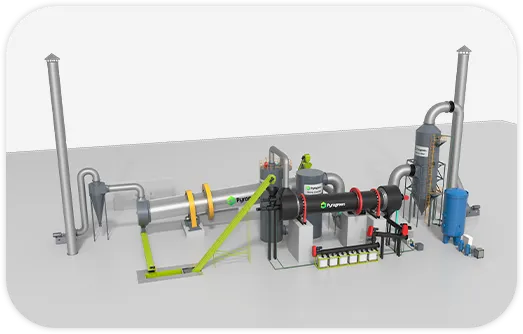
Pyrogreen's biochar making machine uses pyrolysis to convert biomass into biochar, with operating conditions selected to match the feedstock and required product properties.
Reaction conditions and recoverable products
|
Selection factor |
Pyrolysis |
Gasification |
Combustion |
|
Reaction environment |
Oxygen excluded from the decomposition stage |
Reactive gas such as air, oxygen, steam or CO2; conditions prevent full oxidation |
Enough oxygen for combustion, usually with excess air |
|
Main useful output |
Char, liquid or gas, depending on operating conditions |
Combustible producer gas, often called syngas |
Heat, hot water or steam |
|
Carbon destination |
Divided among char, vapours and gas |
Mostly directed toward gas; some char may remain |
Mostly converted to CO2; mineral ash remains |
|
Heat arrangement |
Heat supplied to decomposition, potentially through burning co-products |
Partial oxidation or an external heat source supplies reaction heat |
Fuel oxidation releases heat |
|
Required downstream equipment |
Char cooling; gas combustion or recovery; condensation if liquids are collected |
Gas handling and cleaning matched to its use |
Heat exchanger or boiler, ash handling and flue-gas controls |
Temperature alone cannot classify a plant
Penn State describes introductory pyrolysis conditions around 400–600 °C and conventional gasification around 750–1,100 °C. These are illustrative ranges: hotter pyrolysis routes exist, and a gasifier contains zones at different temperatures.
Specify the reaction environment, residence time, and product target before choosing an operating temperature.
Choose the process around the product you can use
A buyer for qualified char, a gas-consuming engine, and a factory steam header create different equipment requirements.
Choose slow pyrolysis for a char-led project
Slow pyrolysis generally favours solid recovery, while fast pyrolysis favours liquid bio-oil. A proposal for “pyrolysis equipment” therefore needs a defined operating mode and product specification.
Saleable biochar also needs an accepted feedstock.
Match its chemical and physical properties to the buyer's intended application. A high mass yield alone cannot establish its value.
Choose gasification for a defined fuel-gas use
Select biomass gasification technology around the burner, engine, or chemical process that will consume its gas.
Its composition and heating value depend on the feedstock, gasifying agent, and operating conditions.
The gas consumer sets the cleanup requirement. Tar and particles can foul downstream equipment, while catalytic synthesis requires tighter contaminant control; a gas that burns successfully is not automatically suitable for an engine or synthesis catalyst.
Choose combustion for a heat-led project
Direct combustion deserves an early evaluation when the site needs dependable heat or steam and has no planned market for char or fuel gas. A biomass boiler can supply process steam directly or feed a turbine where the scale and steam conditions justify it.
Define the steam pressure, heat-delivery temperature, and demand schedule before adding conversion stages.
Draw the boundary around the complete plant
A gasifier can contain drying, pyrolysis, oxidation, and reduction within the same conversion system.
A burner can support pyrolysis
In a char-focused pyrolysis plant, combustible gas and vapours can provide process heat through controlled combustion. Purchased fuel demand then depends on startup, feed moisture, heat losses, and the chosen recovery arrangement.
Calling decomposition a heat-requiring reaction does not establish the plant's ongoing external fuel consumption. Request a heat balance showing which streams supply each thermal duty.
Recovering char changes the gasification balance
Gasification can leave recoverable char, although converting more carbon into gas reduces the carbon available for solid recovery. Char quantity and suitability therefore need their own guarantees.
Pyrogreen's integrated biomass carbonization solutions include heat-recovery, boiler, and gas-treatment configurations.
Assess any proposed configuration against the combined product and energy duties at your site.
Test the feedstock before comparing quotations
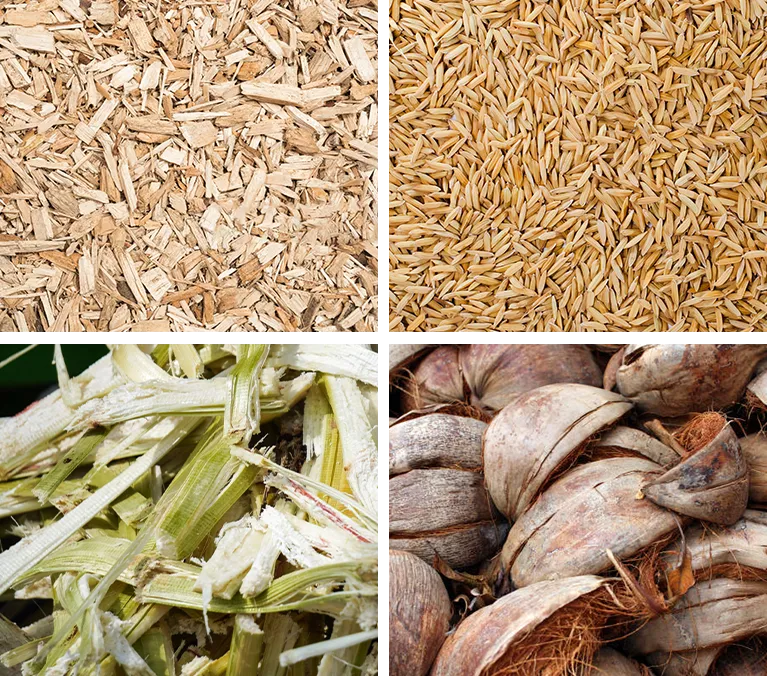
Moisture, particle-size spread, bulk density, and ash chemistry can eliminate unsuitable configurations before price becomes useful.
Moisture changes the heat balance
Water must be heated and evaporated, reducing the energy available for other duties. Some boilers accept wetter biomass than particular gasifier or pyrolysis designs, but every proposal still needs an explicit feed-moisture envelope.
Record moisture on a wet or dry basis, throughput as received and as dry solids, and the drying duty. A capacity figure without these conditions is difficult to compare.
Minerals and handling affect availability
Ash percentage alone misses problems caused by its composition. Alkali-rich material can contribute to deposits and slagging, while chlorine can aggravate corrosion in hot equipment.
Fine sawdust and coarse chips also behave differently in storage, feeders, and gas paths. Ask for trials using representative feedstock, including seasonal variation, and examine how preparation and ash handling affect maintenance access.
Compare net output without double counting
Gross gas production, generator output, and recoverable heat measure different things; each needs a defined accounting boundary.
Use a common measurement basis
Compare quotations at the same feed condition, throughput, and heating-value basis. Higher heating value and lower heating value give different denominators, so an efficiency percentage needs its stated basis.
Report net electricity after auxiliaries, useful exported heat after internal consumption and losses, and qualified char output separately. Cold-gas efficiency describes energy retained in gas before its final conversion; it cannot substitute for net electrical efficiency.
Allocate heat to one duty at a time
In a hypothetical heat balance, 1.0 MW of recovered heat allocated as 0.6 MW to internal drying and reactor duties leaves 0.4 MW before distribution losses. Electrical auxiliaries require separate accounting.
Count retained char as a product, and recognize that burning it for extra heat consumes that product. Require a balance that prevents the same material or energy stream from earning two revenues.
Check gas cleanup and stack emissions separately
A clean fuel-gas stream and compliant stack emissions require different checks.
For gasification, verify contaminant limits where the gas enters the burner, engine, or synthesis unit. Then assess emissions from that downstream equipment. For combustion, evaluate the furnace, particulate capture, and any further controls required by the fuel and local permit.
Pyrolysis also needs controlled treatment or use of its gas and vapours. Producing char does not eliminate exhaust management.
Carbon storage needs a separate assessment of the retained material and its end use. Char burned later as fuel serves an energy function; durable storage requires an appropriate pathway and evidence.
Ask for an emissions-control scope and monitoring plan covering startup, normal operation, and shutdown before treating any route as inherently cleaner.
Write the acceptance test before the equipment list
Turn the preferred route into an acceptance test using representative feedstock. Set the feed-moisture range, throughput basis, product specification, net energy delivery, and emissions conditions together.
Require those outcomes during the same operating test. High char yield at one setting and maximum power at another cannot establish a combined production guarantee. Agree on the test duration, sampling method, and treatment of off-specification output before comparing offers.
The equipment list should follow that operating requirement. Issue the same acceptance conditions to each shortlisted supplier so the final choice reflects the useful output your project can actually depend on at the stated feedstock and load.
CONTACT US
Contact US
Product Information
Quantity
Unit
Piece
Support order samples, customization, wholesale direct, and complete payment. If the product you look for does not have corresponding customized content, pls fill out the form below to contact us, and we will reply ASAP.