


.webp?x-oss-process=image/resize,w_800/quality,q_100)
.webp?x-oss-process=image/resize,w_800/quality,q_100)
Sawdust in Continuous Pyrolysis: Feeding, Dust and Air-Seal Challenges
Sep 24, 2026
Sawdust in Continuous Pyrolysis: Feeding, Dust and Air-Seal Challenges
Sawdust looks like an ideal continuous pyrolysis feedstock because it is already small. Yet a reactor can run below its rated capacity while a hopper bridges, a screw delivers an uneven mass flow, or air enters through a worn feed seal. Fine particles also create a combustible-dust problem before they ever reach the hot zone.
The practical question is whether the whole feed train can deliver a measured mass of sawdust while keeping dust contained and maintaining the intended reactor atmosphere. Start that assessment with the material delivered to the plant, not a clean sample or a brochure throughput figure.
Specify the sawdust before choosing the machine
Specify moisture, particle-size distribution, loose bulk density, and contaminants for delivered sawdust. A nominal species or average particle size does not describe the fines, long shavings, bark, grit, and wet pockets that decide how a hopper and feeder behave.
When comparing biochar production equipment, ask each supplier to state the feed envelope its proposed complete line can handle. Record moisture on a wet basis, include the proportion of fines and oversize pieces, and sample bulk density after the same storage and handling steps planned for the site. A drying step can change both the material's flow behavior and its dust burden.
Small particle size alone is no guarantee of easy feeding. Biomass-feeding research reports bridging, ratholing, blockage, and seal failures across different feed materials and equipment. Screen out stones and metal, then test the least free-flowing expected sawdust rather than designing around an unusually clean batch.
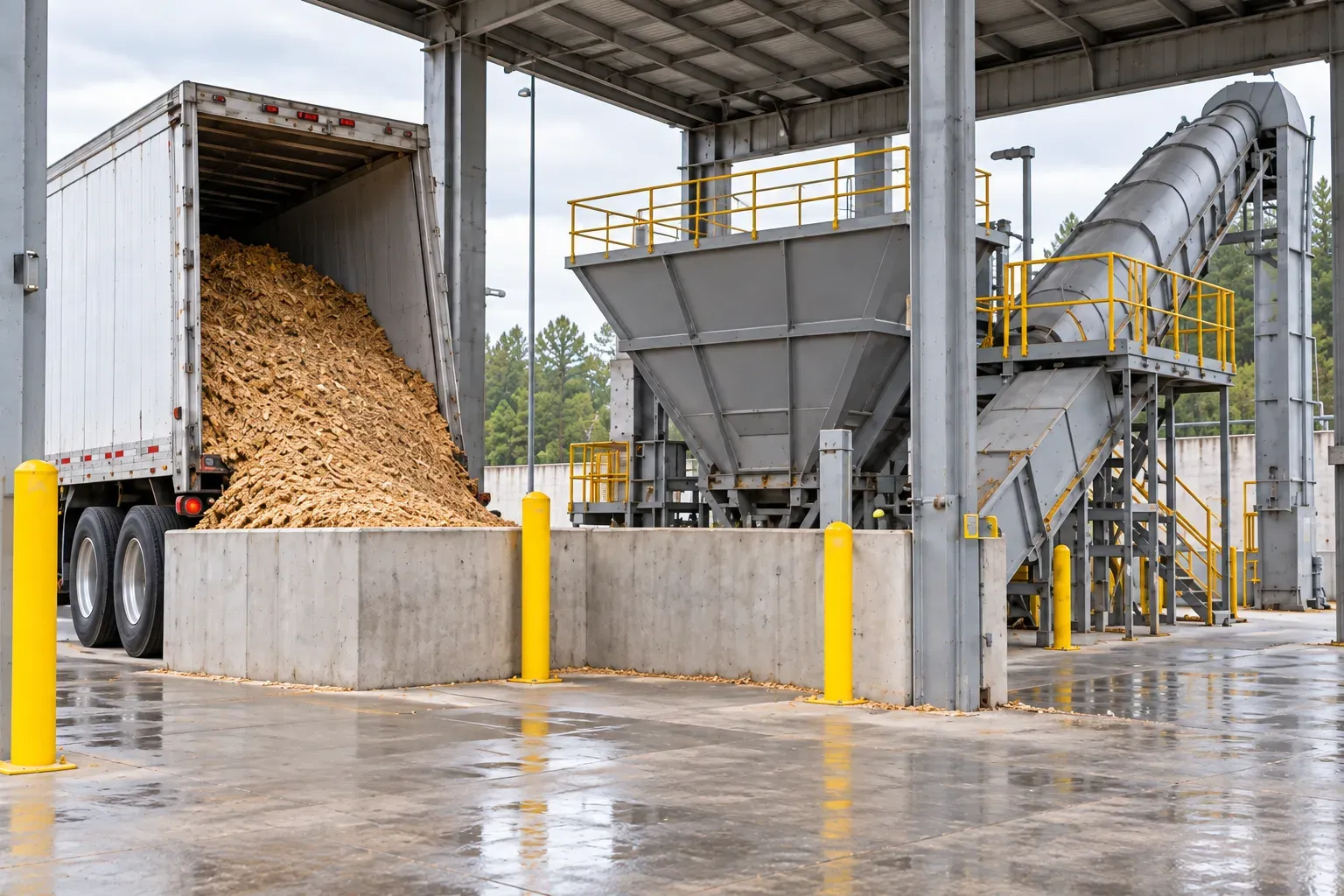
Meter mass flow, not screw speed
A screw feeder moves a volume of material per revolution; the reactor receives mass and associated moisture and heat demand. Changes in bulk density, screw fill, and slip can therefore change the actual feed rate even when the drive speed stays constant.
Calibrate delivered mass
Consider a hypothetical screw delivering 1 m³/h. With a loose bulk density of 120 kg/m³, it supplies 120 kg/h; at 180 kg/m³, it supplies 180 kg/h. That is a 50% increase in mass at the same volumetric rate. These figures illustrate the calculation, not a typical sawdust density or a promised equipment capacity.
Watch the feeder trend
Measure delivered mass over timed intervals at the intended feed settings, including low hopper level and restart after a pause. Log screw speed alongside mass rate, motor load, moisture, and material source. A rising motor load with falling delivery can signal packing or a developing obstruction; increasing the speed alone may make the problem worse.
Use this measured operating range to size the feeder, reactor heat input, and gas handling. Compare proposed configurations by their tested feed limits and upstream metering arrangements for the actual sawdust.
Contain dust at every transfer point
Drying, screening, conveying, hopper filling, and valve discharge can all release wood fines. Capture dust where it is generated, enclose transfer points where practical, and give operators safe access to inspect and clean the system. Sawdust deposits on beams, equipment tops, and cable trays matter even when the floor looks clean.
Wood dust can burn or explode when dispersed under the wrong conditions. A collector therefore needs a site-specific review of ignition sources, collection location, explosion protection, and isolation from connected equipment. Do not treat a filter as a complete safety system or use compressed air to blow settled dust back into a cloud.
The upstream dust-collection path and the hot process-gas path serve different purposes. Any proposed connection between them needs explicit engineering review for combustible gases, oxygen, temperature, and pressure. Map each sawdust transfer and its collection point before finalizing the plant layout.
Design the air seal as a system
The critical gas boundary is the route from an atmospheric sawdust hopper into a hot, oxygen-controlled reactor. A rotary valve can limit leakage, but it is a moving clearance device, not a promise of zero gas flow. Leakage also changes with wear, pressure difference, and the amount of material occupying its pockets.
Choose the boundary for the pressure profile
Depending on reactor pressure and feed behavior, the design may use a rotary valve, a lock hopper, a dense material plug, a purge, or a combination. The right arrangement must prevent unwanted air ingress and pyrolysis-gas backflow during normal feeding and when the hopper is nearly empty. A continuous reactor should not lose its gas boundary each time the feed supply pauses.
Prove the seal during changes of state
Show the pressure profile from storage through the feeder to the reactor. Specify where pressure, oxygen, or combustible-gas measurements are needed, and define what alarms or stops the feed when the boundary fails. The setpoints and purge sequence belong in a project-specific process and safety design, not in a generic equipment claim.
Test sealing during startup, steady operation, low feed, blockage recovery, and shutdown. Include hot, dusty, and partially worn conditions in the acceptance test rather than relying on a cold, full-hopper demonstration.
.webp)
Stop heat from creeping back into the feeder
The feeder can begin to foul before sawdust enters the intended reaction zone. Oak Ridge National Laboratory researchers examined a failed pyrolysis screw feeder and linked deposits and plugging to biomass heating along the feeder's temperature gradient. That finding does not define a universal temperature limit, but it makes the reactor-entry section a necessary inspection point.
Check the thermal break or cooling arrangement where the feed conduit meets the reactor, and monitor temperatures at locations that can show heat traveling upstream. During a trial, inspect for sticky deposits, char formation, torque drift, and material left in the screw after stopping. Set a shutdown and cleanout procedure that addresses residual hot material before an operator opens the line.
Make a whole-line trial the acceptance test
A useful sawdust trial runs from receiving through dust capture, feeding, reactor entry, and safe discharge. A brief demonstration at one steady feed setting may miss the conditions that cause real downtime.
Record the full process train
|
Check |
Evidence to collect |
Failure signal |
|
Feedstock |
Wet-basis moisture, size distribution, loose bulk density, contaminants |
Delivered lots fall outside the tested envelope |
|
Flow |
Timed mass rate, screw speed, motor load, hopper level |
Rate swings, bridging, packing, or rising torque |
|
Dust |
Visible releases, deposits, collector operation, maintenance access |
Escaping fines or dust buildup around transfers |
|
Gas boundary |
Pressure profile and project-specific gas measurements across feed states |
Air ingress, gas backflow, or loss of seal at low feed |
|
Hot interface |
Feed-conduit temperatures, deposits, restart behavior |
Heat-back, fouling, or difficult cleanout |
Set pass criteria before testing
Agree on acceptance criteria before the trial, including the allowable variation in mass rate and the response to abnormal pressure or gas readings. Check both dry and wetter representative lots if the supply changes seasonally.
Review Pyrogreen's integrated biomass carbonization solutions when buying a complete plant. Request evidence for the proposed preparation, reactor, gas-handling, and discharge configuration rather than transferring results from another feedstock.
Buy the operating envelope
The useful equipment specification is not simply how much sawdust fits through a screw at full speed. It is the range of real sawdust the line can meter continuously while controlling dust, keeping the reactor gas boundary intact, and allowing safe recovery from a fault.
Give suppliers representative feed samples and a written test protocol. Require measured mass-flow stability, a documented pressure and gas-seal strategy, dust-control provisions, and access to inspect the hot feed interface. If those points remain undefined, a higher reactor capacity will not make the plant more reliable.
CONTACT US
Contact US
Product Information
Quantity
Unit
Piece
Support order samples, customization, wholesale direct, and complete payment. If the product you look for does not have corresponding customized content, pls fill out the form below to contact us, and we will reply ASAP.